Improving In-Vehicle Infotainment Systems for Professional Drivers: Generative & Evaluative Research
BACKGROUND

Low usage of In-Vehicle Infotainment systems

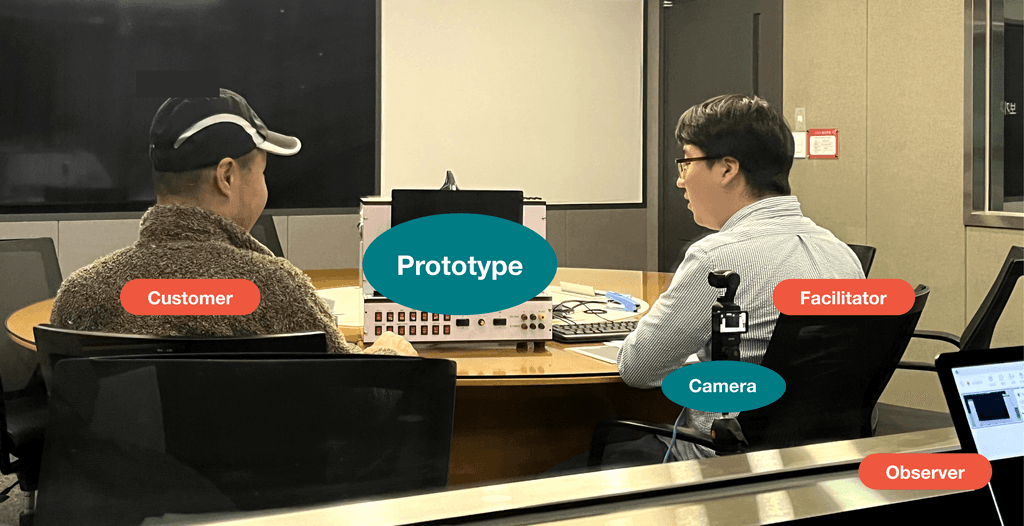
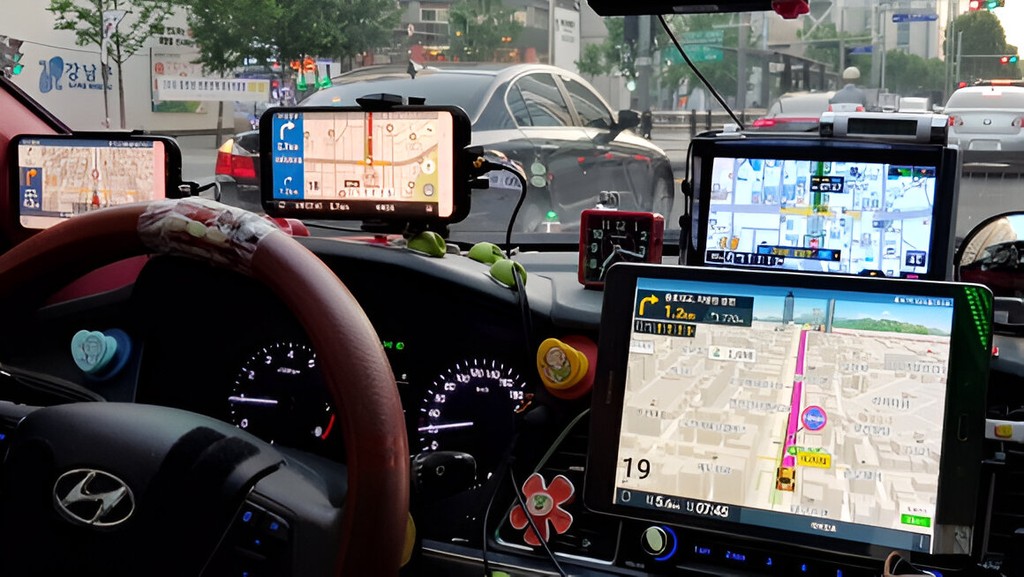
Professional drivers rely on external devices instead of the In-Vehicle device.


As the client company shifted their focus to purpose-built vehicles (PBVs), their target users narrowed from general consumers to professionals using vehicles for business purposes. These users relied on 3+ external devices such as smartphones and tablets, highlighting a disconnect between their needs and the system’s functionality.

ROLE

UX Research Intern

  • Operation: Recruiting & scheduling.

  • Research design: Collaborated with team to develop research protocols.

  • Co-moderation: Conducted 30 usability tests & take notes.

  • Data analysis: Synthesized qual & quant findings to identify mental models and prioritized product improvements.

  • Final report

DURATION

April – May 2024 (3 weeks)

TEAM

4 UX Researchers

CLIENT

'H' Motor Group, a leading mobility company

COMPANY

PROBLEM

The IVI system was designed without real-world user data.

The client struggled to persuade stakeholders due to unclear design rationale.


Before moving to mass production, the client needed to enhance the competitiveness of their IVI and Cluster systems. However, the redesign was guided by intuition, and the absence of user-driven data made it challenging to convince internal stakeholders to allocate the technical and financial resources.

APPROACH

> Identify customer archetypes and their digital device usage in vehicles.

> Understand why they don't use IVI device.

> Test re-designed prototypes' usability.

> Deliver actionable insights and prioritize improvement requirements.

IMPACT

Refining Assumptions & Aligning Stakeholders

  1. We identified key faulty product assumptions:

  • Applying interactions of mobile device existing In-Vehicle systems would improve usability.

  • Users would be familiar with iOS Android OS interactions.

  • Users would need don't want profile system for saving personal settings

  • Applying interactions of mobile device existing In-Vehicle systems would improve usability.

  • Users would be familiar with iOS Android OS interactions.

  • Users would need don't want profile system for saving personal settings

  • Applying interactions of mobile device existing In-Vehicle systems would improve usability.

  • Users would be familiar with iOS Android OS interactions.

  • Users would need don't want profile system for saving personal settings

  1. The research report empowered the client to persuade stakeholders and prioritize feature development.

HOW MY TEAM AND I ( + OUR CLEINT :D ) MADE IT !
CHALLENGE

Time-constrained: conducting comprehensive research in three weeks

  1. Recruit participants in niche community

Recruited 30 participants across four unique customer groups within a limited timeframe. It was even more challenging as the client specifically requested participants using a low-demand vehicle model.

-> Simultaneously conducting secondary research on online communities & social media, I compiled a list of eligible participants and reached out to them.

-> Simultaneously conducting secondary research on online communities & social media, I compiled a list of eligible participants and reached out to them.

-> Simultaneously conducting secondary research on online communities & social media, I compiled a list of eligible participants and reached out to them.

  1. Handling analogue data

Many participants (avg. age 45) were not comfortable with digital tools. We conducted offline surveys, resulted in a large volume of handwritten data.

-> Digitized and Organized all survey and observation data using Excel, ensuring seamless communication with the team and the client.

-> Digitized and Organized all survey and observation data using Excel, ensuring seamless communication with the team and the client.

-> Digitized and Organized all survey and observation data using Excel, ensuring seamless communication with the team and the client.

RESEARCH PLANNING

Clarifying Objectives and Defining Research Methods

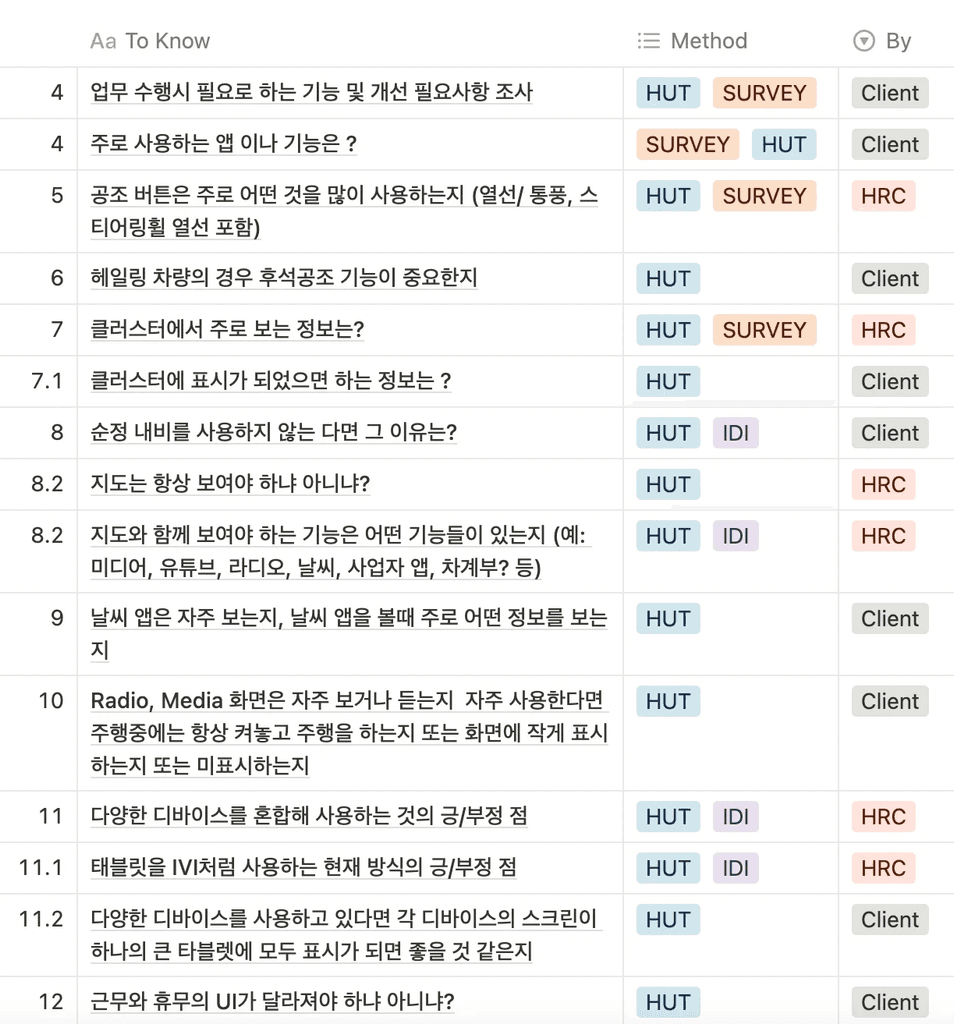
Based on the client’s to-know list, I defined research methods and developed research protocols. The team actively communicated with client to refine research objectives.

To-know list
Research methods
Truckers
Taxi drivers
Survey
  • What apps or functions are most frequently used?

  • What HVAC controls are commonly adjusted?

  • Why do users avoid built-in navigation systems?

*Deliver surveys through in-person to accommodate participants with low digital literacy.

Survey
  • What apps or functions are most frequently used?

  • What HVAC controls are commonly adjusted?

  • Why do users avoid built-in navigation systems?

*Deliver surveys through in-person to accommodate participants with low digital literacy.

Survey
  • What apps or functions are most frequently used?

  • What HVAC controls are commonly adjusted?

  • Why do users avoid built-in navigation systems?

*Deliver surveys through in-person to accommodate participants with low digital literacy.

Shadowing & Interview
  • Usage of IVI systems during work.

  • How users mix multiple devices?

Shadowing & Interview
  • Usage of IVI systems during work.

  • How users mix multiple devices?

Shadowing & Interview
  • Usage of IVI systems during work.

  • How users mix multiple devices?

———————>

(Researchers couldn't ride taxi during work hours)

—————>

(Researchers couldn't ride taxi during work hours)

—————>

(Researchers couldn't ride taxi during work hours)

Video Ethnography & Diary Study
  • Usage of IVI systems during work.

  • How users mix multiple devices?

Video Ethnography & Diary Study
  • Usage of IVI systems during work.

  • How users mix multiple devices?

Video Ethnography & Diary Study
  • Usage of IVI systems during work.

  • How users mix multiple devices?

In-lab Usability Testing & A/B Testing
  • Evaluate multitasking capabilities, button layouts, and workflows for frequent tasks.

  • Readability and Accessibility: Test font sizes, display clarity, and adaptability to different user needs

  • Critical Information: Validate placement and visibility of essential data during active tasks (e.g., maps, notifications, and control panels).

In-lab Usability Testing & A/B Testing
  • Evaluate multitasking capabilities, button layouts, and workflows for frequent tasks.

  • Readability and Accessibility: Test font sizes, display clarity, and adaptability to different user needs

  • Critical Information: Validate placement and visibility of essential data during active tasks (e.g., maps, notifications, and control panels).

In-lab Usability Testing & A/B Testing
  • Evaluate multitasking capabilities, button layouts, and workflows for frequent tasks.

  • Readability and Accessibility: Test font sizes, display clarity, and adaptability to different user needs

  • Critical Information: Validate placement and visibility of essential data during active tasks (e.g., maps, notifications, and control panels).

KEY DELIVERABLES
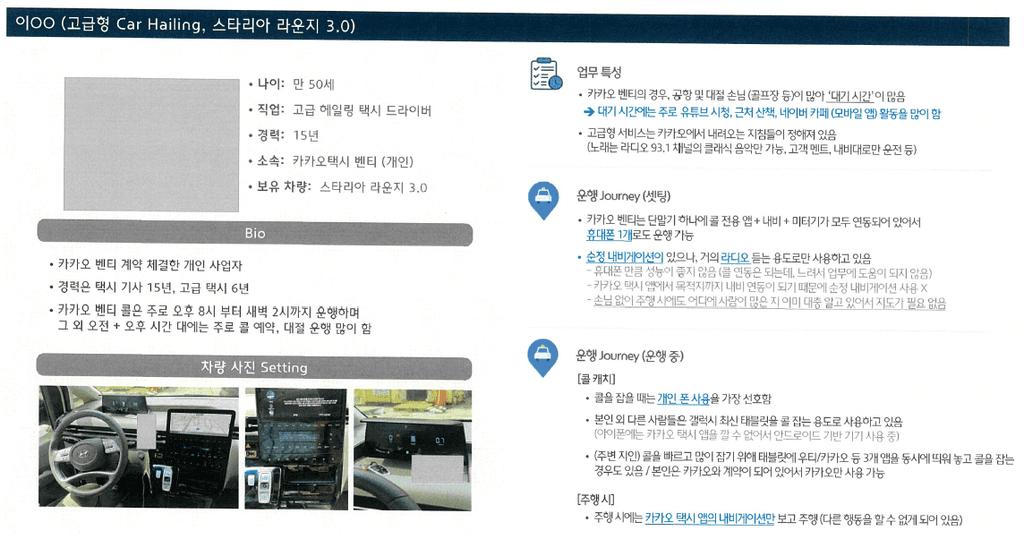
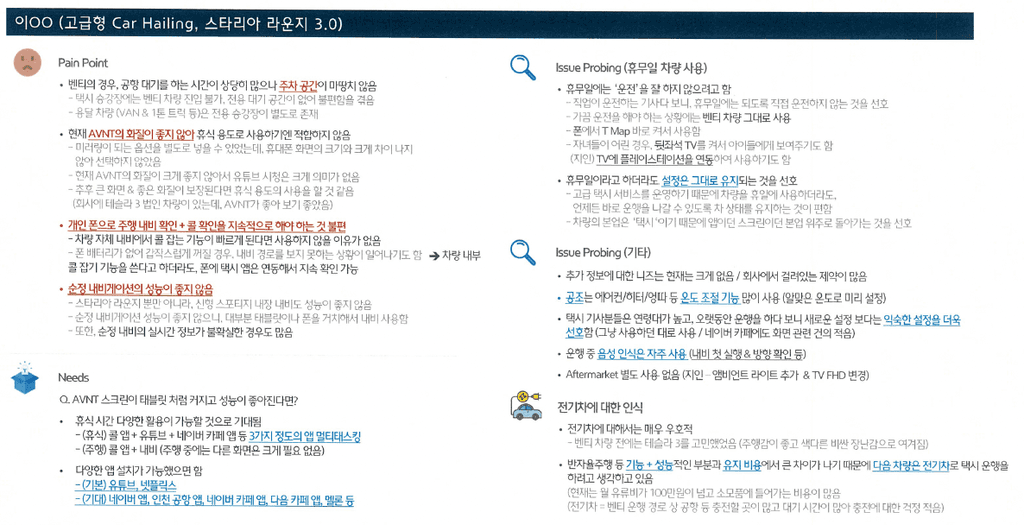
  1. Customer personas

Created customer personas based on survey, interview, and observation data to define pain points and needs.
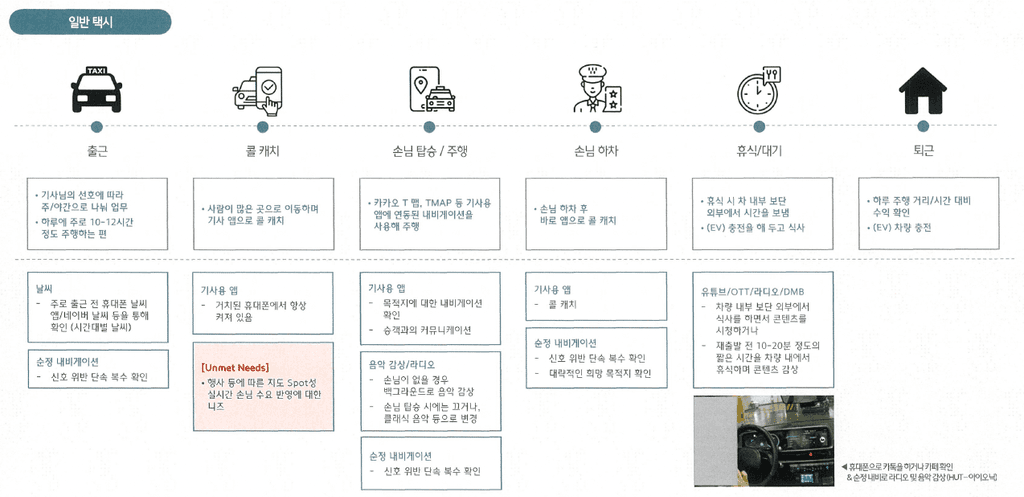
  1. Customer journey map

Identified unmet needs of four customer groups using customer journey mapping.
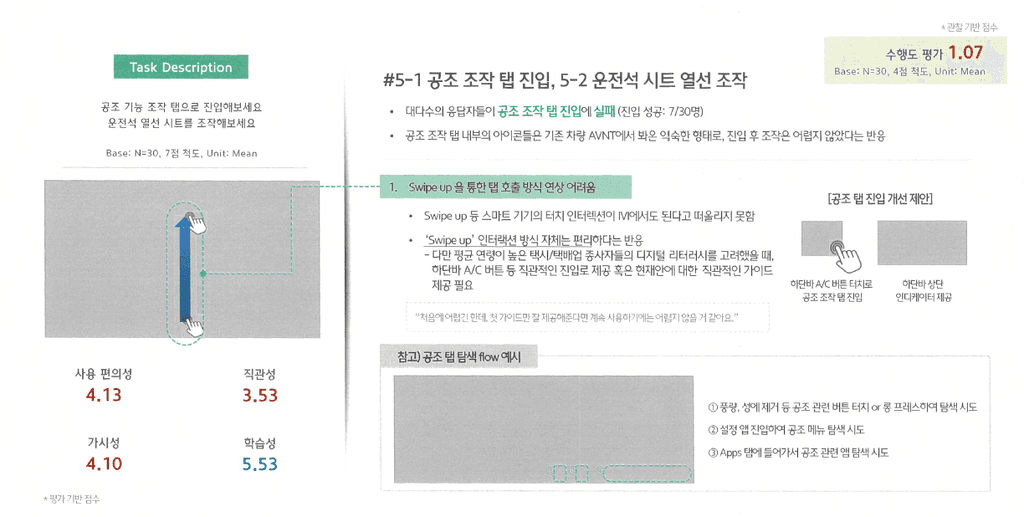
  1. Usability evaluation & improvement recommendations

Quantified usability by combining user self-assessments across four metrics with facilitator observations. Prioritized improvements and recommended solutions.
Create a free website with Framer, the website builder loved by startups, designers and agencies.